
Python: Operations
COMPARISION, LOGICAL, MEMBERSHIP OPERATIONS
Operations allow you to perform actions on variables and values.
A- Comparison Operations
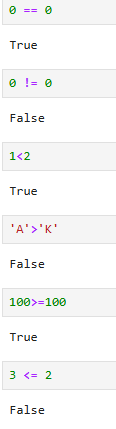
Comparison operations are the simplest. To summarize briefly:
• == equals
• != not equal
• > greater than
• < less than
• >= greater than or equal to
• <= less than or equal to
The result of these operations is either True or False.
Note: You can also compare strings (character data). The character that comes later in the alphabet is always greater. For example, "Ayşe < Zeliha" is correct.
B- Logical Operations
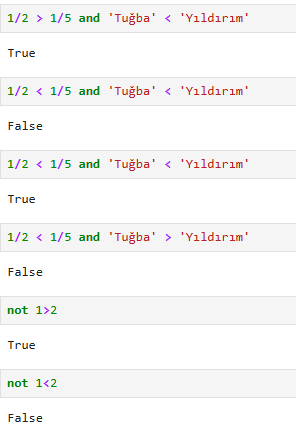
• And: Returns True if both values you provide are True.
• Or: Returns True if at least one of the values you provide is True.
• Not: Returns the opposite of the given value. If the result is True, it becomes False.
C- Membership Operations
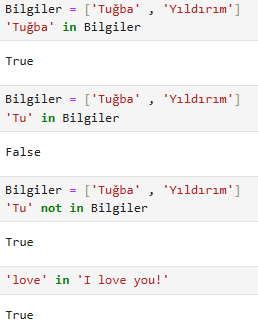
• In: Returns True if the value you are checking exists within the provided sequence (list, string, or other sequence).
• Not in: Returns True if the value you are checking does not exist within the provided sequence.
Now you have a solid understanding of operations in Python, the essential tools for manipulating and evaluating data!