
Python: Operations
IF/ELIF/ELSE KOŞUL YAPILARI
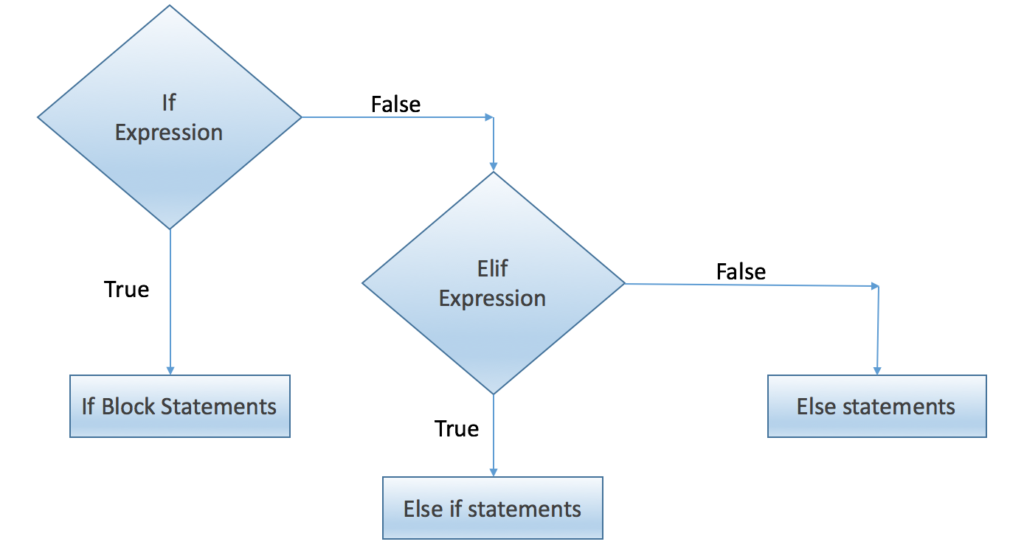
As you can see from the diagram, everything begins with an if statement. When the condition you specify with if evaluates to True, Python executes that code block and skips the rest. If it evaluates to False, Python moves to the elif statement and checks the condition there. If True, Python executes that code block and skips the rest; if False again, it finally enters the else block and attempts to return a result.
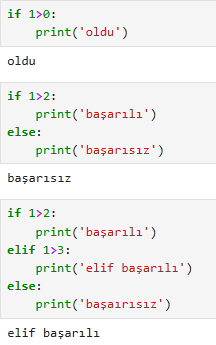
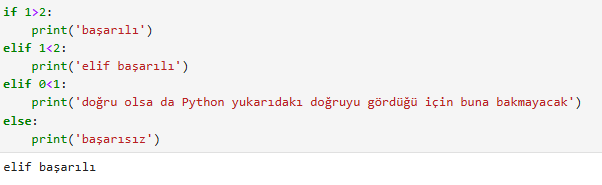
Python stops evaluating as soon as it finds the first True condition. This means that if the first if or elif block executes, the remaining blocks are ignored. Even if your code were as long as the Manas Epic, Python would stop reading further once the first True condition is met.
FOR LOOPS
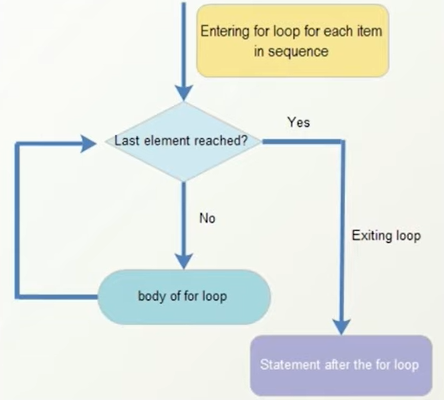
The for loop allows you to process each element of a data set (e.g., in a list, tuple, or dictionary) individually. Python iterates over each element sequentially and checks, "Am I at the last element?" If the answer is no, the loop continues. If yes, it processes the last element and completes the loop.
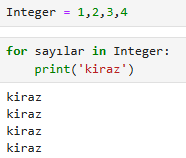
For Loop ve Dictionary Kullanımı
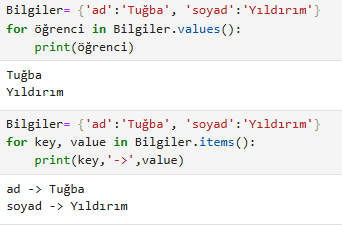
For loops behave slightly differently with the dictionary data type. Dictionaries contain both keys and values, so you must explicitly specify which you want to use during iteration.
If you use Items instead of Values or Keys, Python will retrieve all key-value pairs from the dictionary.
Nested For Loops
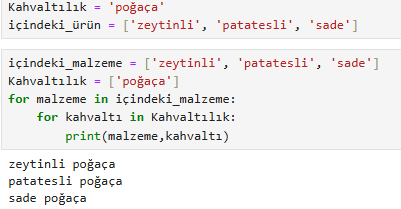
A for loop can contain another for loop inside it. Python executes the outer loop while also iterating through the inner loop. It does not stop at the first correct iteration; it completes all nested loops.
If your first for loop variable contains 1 element and the second for loop variable contains 2 elements, a total of 2 rows of results will be produced.
This occurs because each element of the first variable combines with all elements of the second variable.
Now you have a solid understanding of for loops and nested structures in Python, essential tools for effective iteration and data manipulation!